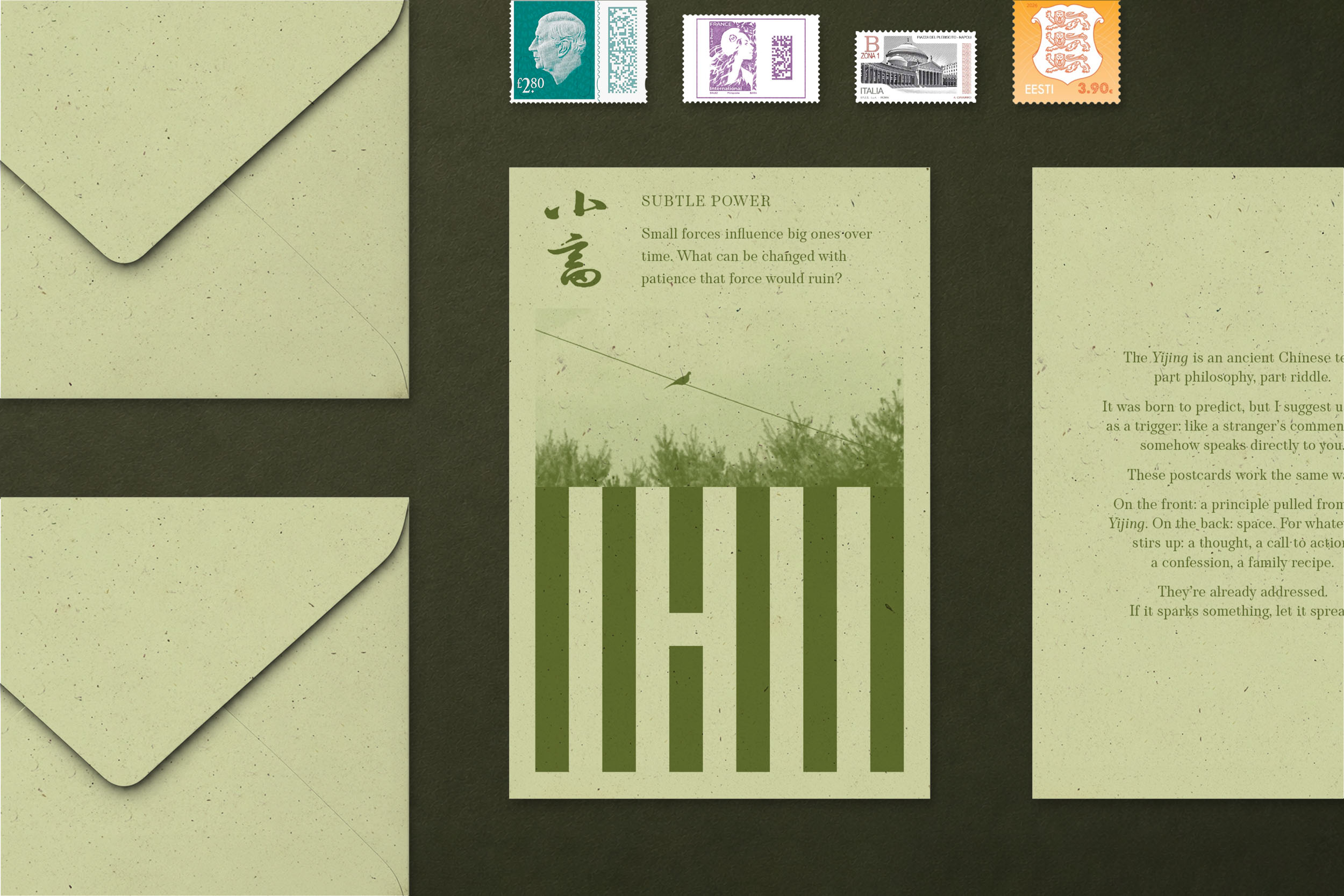
Flat-lay on dark green: a SUBTLE POWER postcard at the centre, showing the hexagram 小畜 and the line 'Small forces influence big ones over time. What can be changed with patience that force would ruin?' Two olive-paper envelopes sit on the left, four postage stamps along the top, and a printed sheet of the project manifesto on the right.

Mail
I Ching

Sixty-four postcards, inspired by the I Ching. Sixteen friends across years and countries, who didn't know each other. Each received an envelope with four postcards to send, and later, four postcards from someone else. The instruction was simple: write something on the back, drop it in the post.

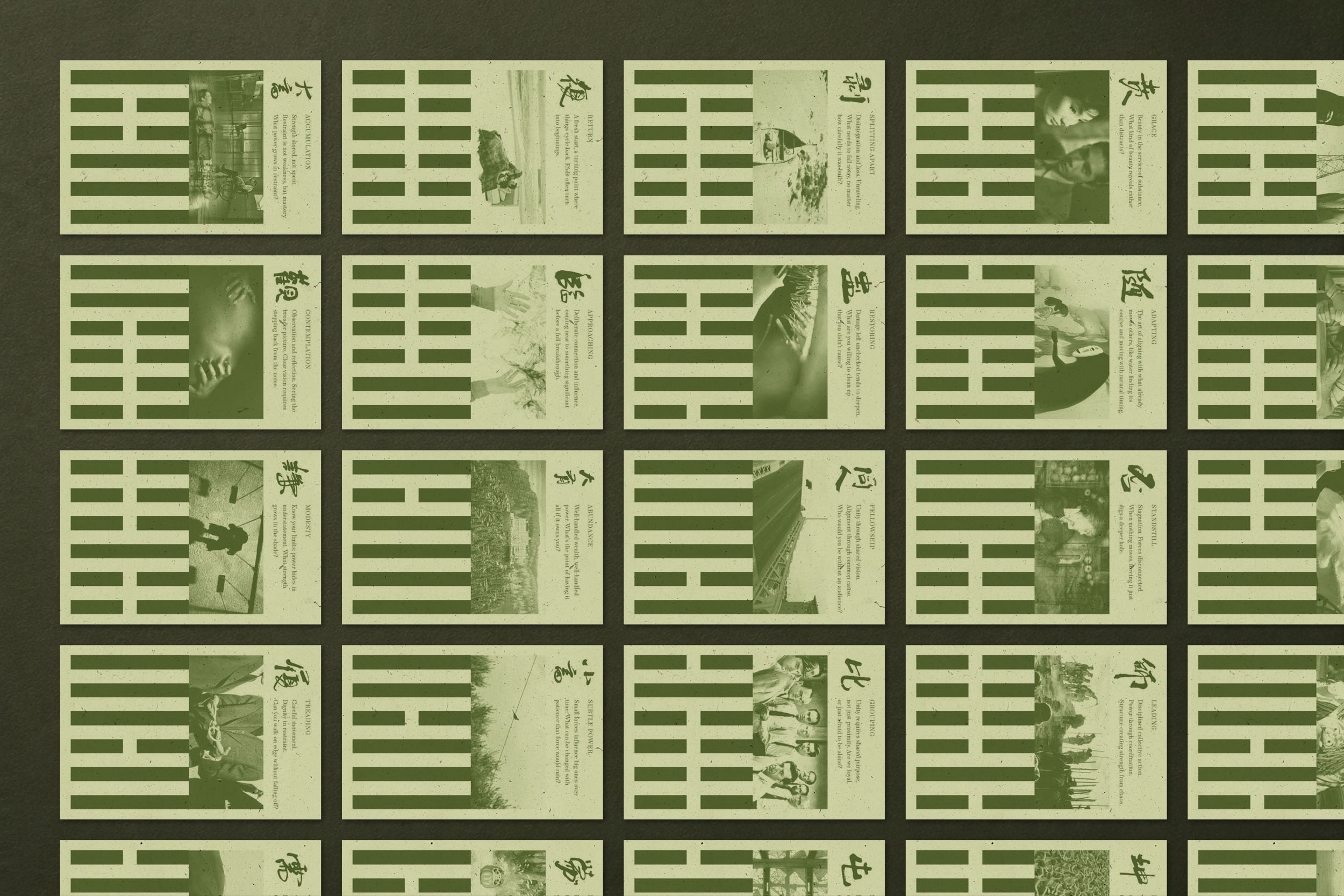
A grid of many Mail I Ching postcard fronts laid out on a dark green surface, showing the project at scale: each card carries a hexagram, a Chinese character, a one-word principle, a short interpretation and a film still.

An oracle, reversed

The I Ching is an ancient Chinese text that uses 64 hexagrams to describe the patterns of change. Traditionally it's consulted as an oracle: you ask a question, you read the answer back into your life. Here that loop is reversed. The hexagram arrives unrequested, addressed to someone who didn't ask, and the recipient has to do the interpreting.
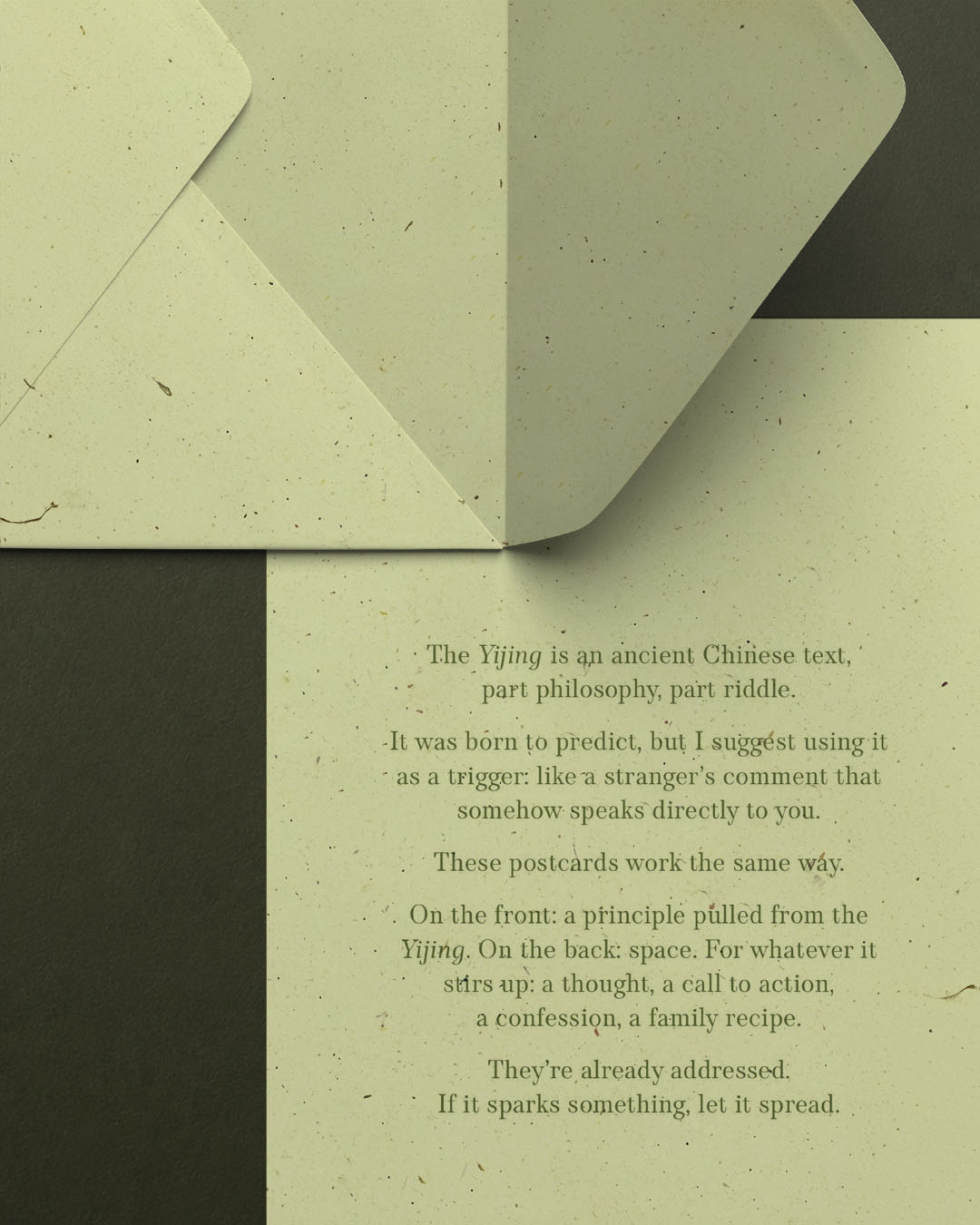
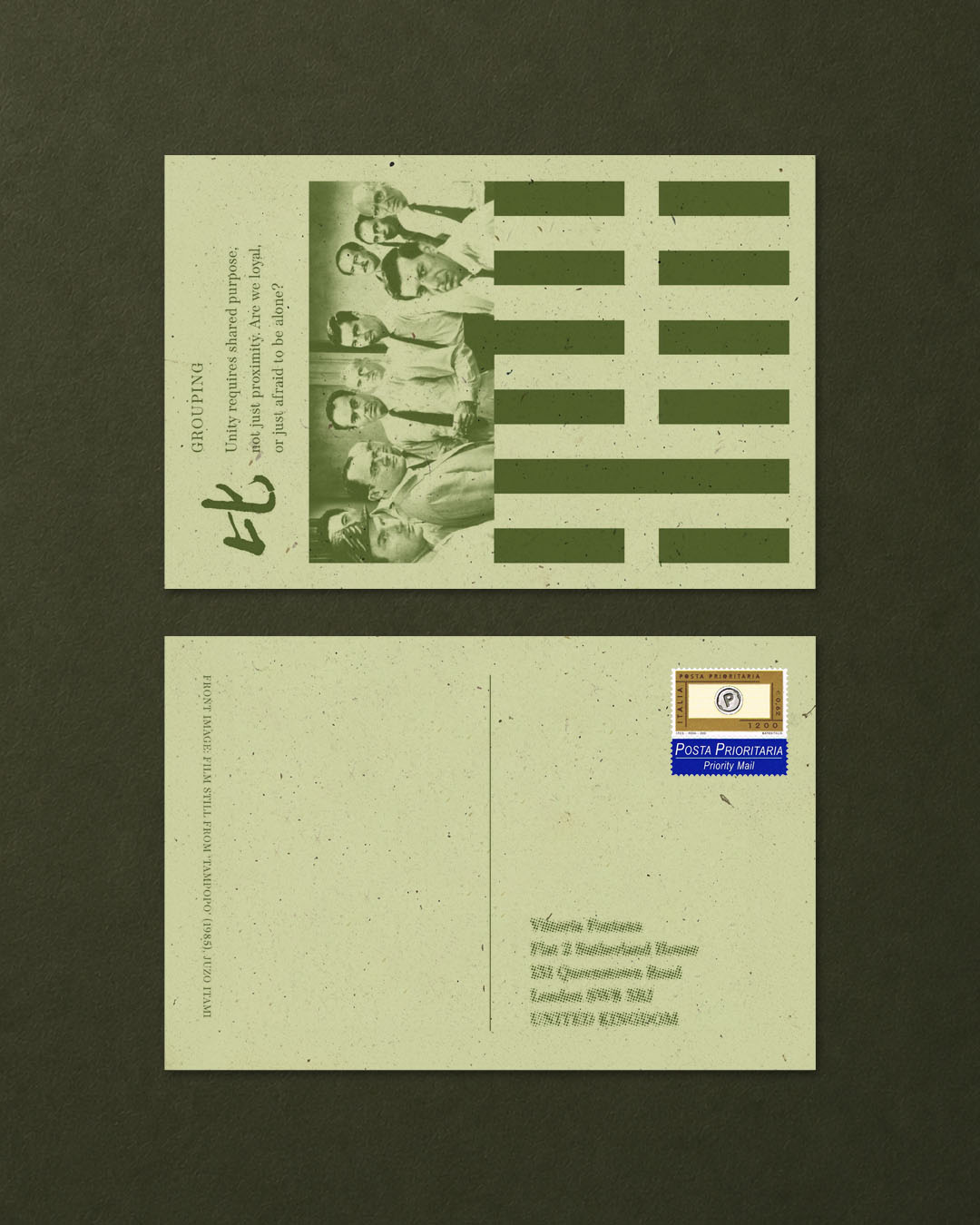
Two open olive-paper envelopes overlap a printed sheet bearing the project manifesto: 'The Yijing is an ancient Chinese text, part philosophy, part riddle. It was born to predict, but I suggest using it as a trigger: like a stranger's comment that somehow speaks directly to you. These postcards work the same way. On the front: a principle pulled from the Yijing. On the back: space. For whatever it stirs up: a thought, a call to action, a confession, a family recipe. They're already addressed. If it sparks something, let it spread.' A GROUPING postcard shown sideways, front and back. The front shows the hexagram 比, the principle GROUPING and the line 'Unity requires shared purpose, not just proximity. Are we loyal, or just afraid to be alone?' over a film still of a row of men in white shirts. The back carries the film credit, a Posta Prioritaria Italia stamp and a hand-addressed recipient.

The cards

On the front: the hexagram, its Chinese character, a one-word principle in English, a short interpretation, and a shot from a film. Each film was chosen because, somewhere in it, the meaning of the hexagram surfaces. On the back: the already filled in address and space to write.
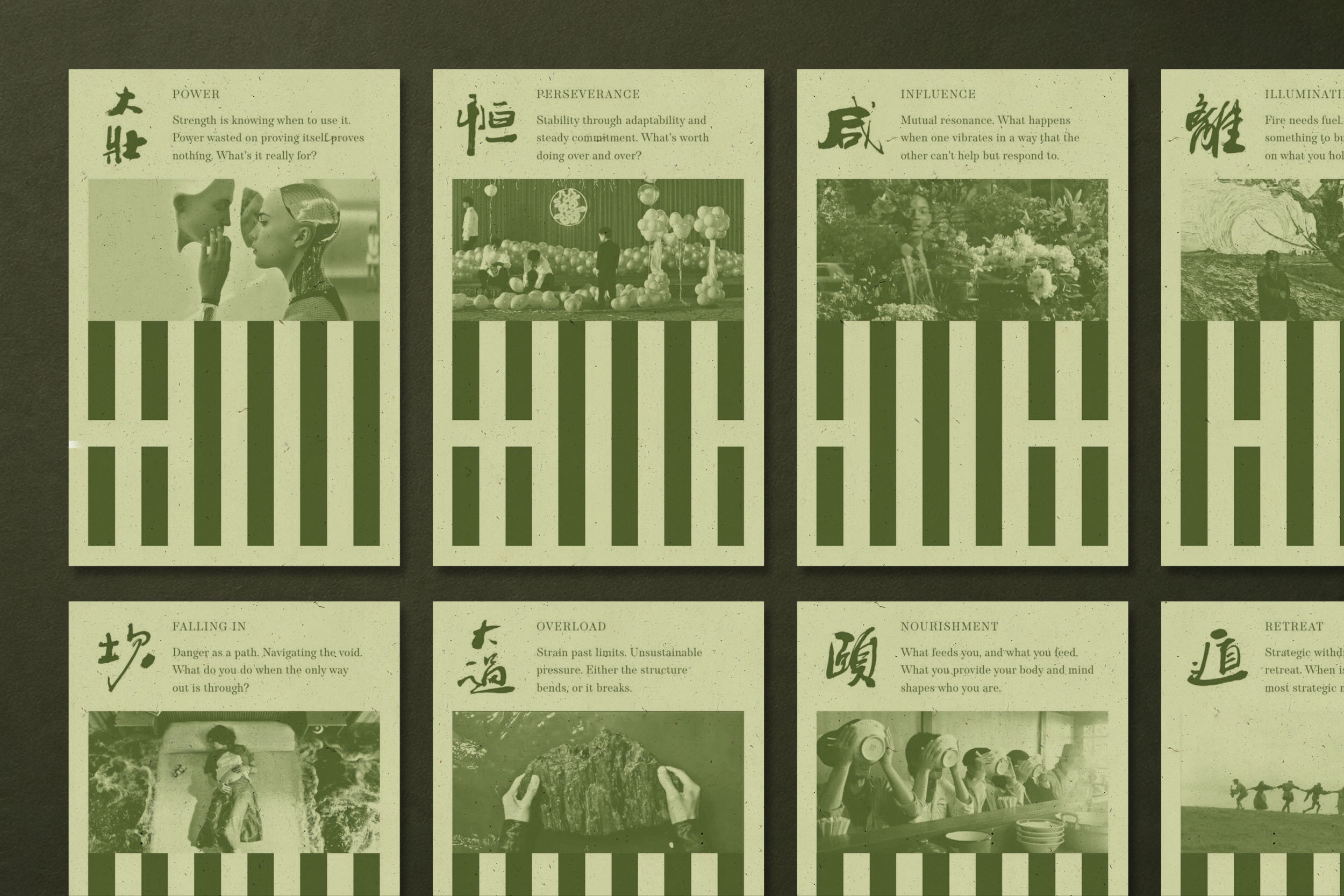
Eight Mail I Ching postcards arranged in a two-by-four grid: POWER, PERSEVERANCE, INFLUENCE, ILLUMINATION on the top row and FALLING IN, OVERLOAD, NOURISHMENT, RETREAT on the bottom. Each shows its hexagram character, principle name, short interpretation and paired film still.
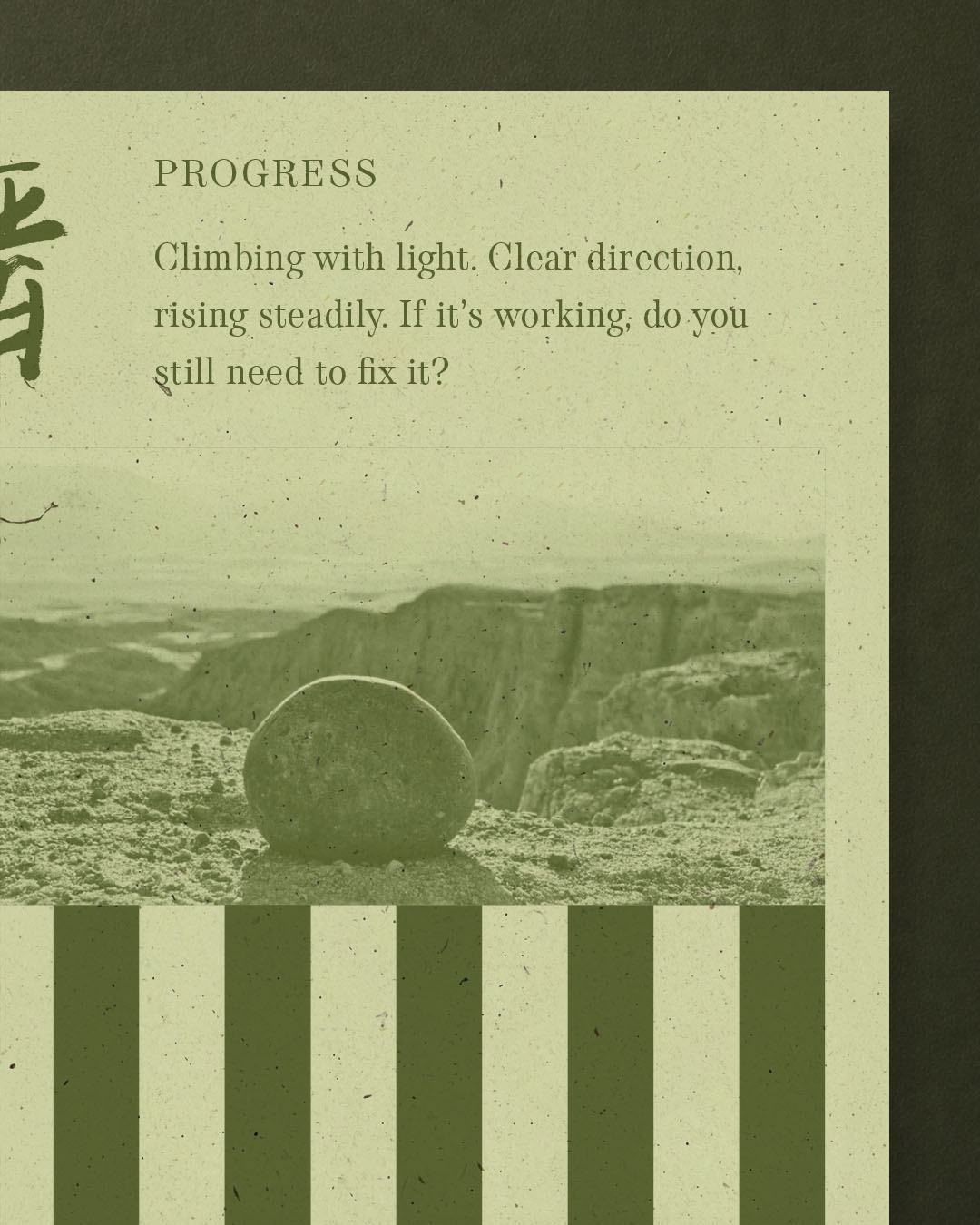
Close-up of a PROGRESS postcard: the hexagram 晉 and the line 'Climbing with light. Clear direction, rising steadily. If it's working, do you still need to fix it?' above a halftone film still of a stone resting on a ridge with a canyon and mountains behind. Close-up of a postcard back credit line, 'FRONT IMAGE: FILM STILL FROM IN THE MOOD FOR LOVE (2000), WONG KAR-WAI', above a halftone close-up of a face in profile.
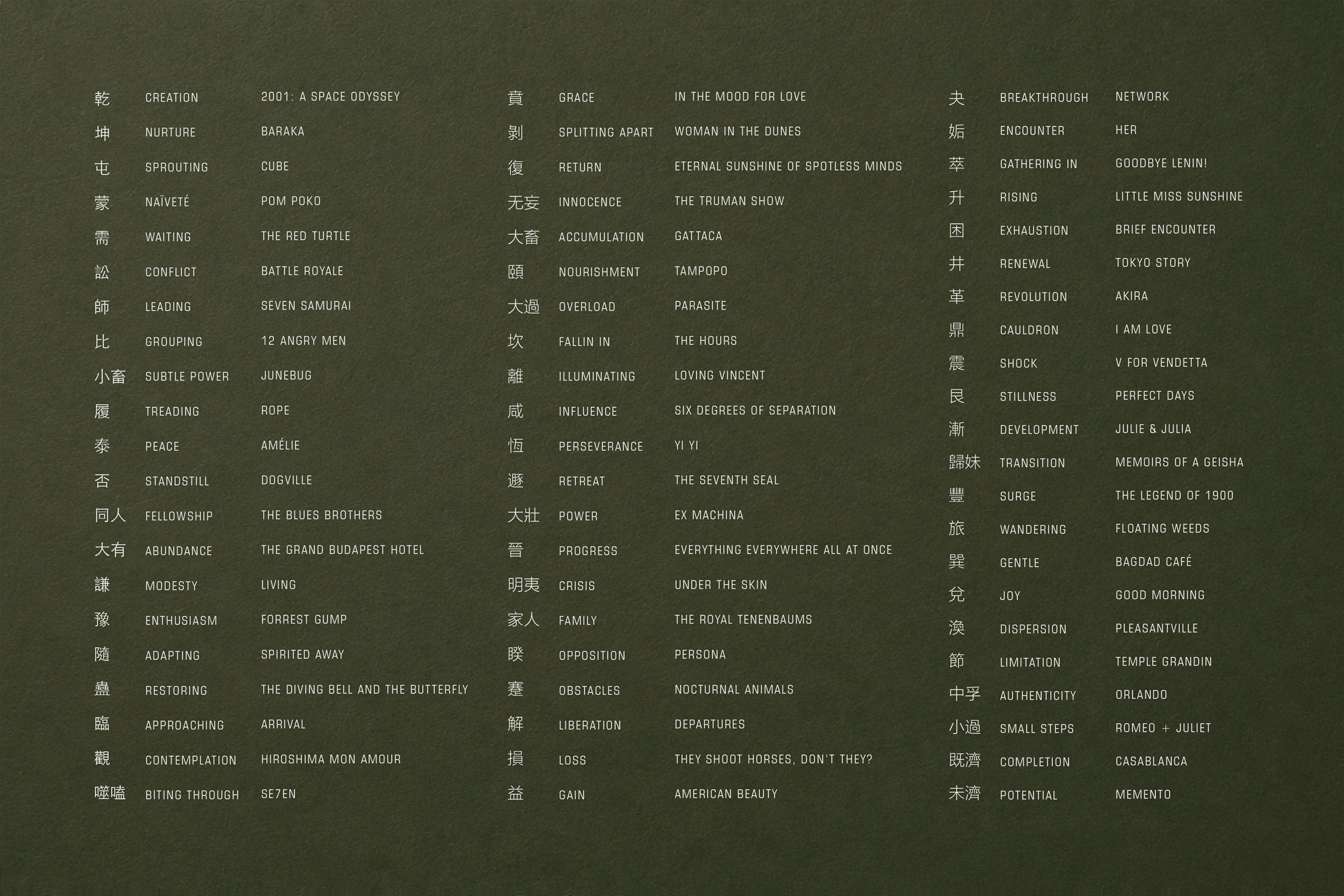
The full index of all 64 hexagrams set in three columns on a dark green ground, each row pairing the Chinese character, the English one-word principle and the matched film title: Creation / 2001: A Space Odyssey, Nurture / Baraka, Sprouting / Cube, and so on down to Completion / Casablanca and Potential / Memento.

A network of strangers

I designed the cards and mailed them in an envelope to 16 friends. They wrote the messages and posted them onward. Nobody chose where their cards went; nobody knew why theirs had come. A postcard is the right object for this: private enough to carry a message, public enough to be read along the way whoever briefly handles it. Some have landed. Some are still moving. Some, maybe, won't make it.
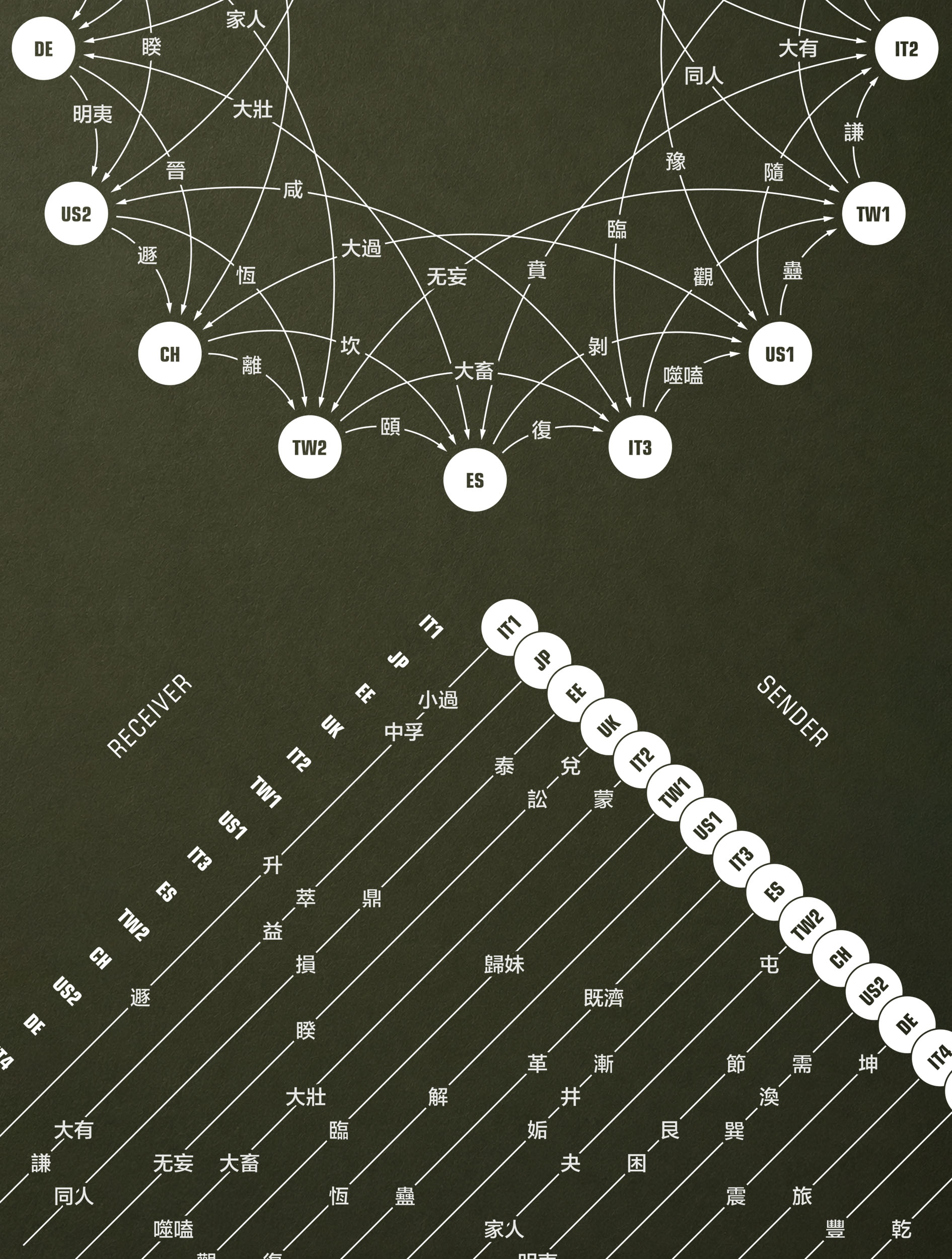
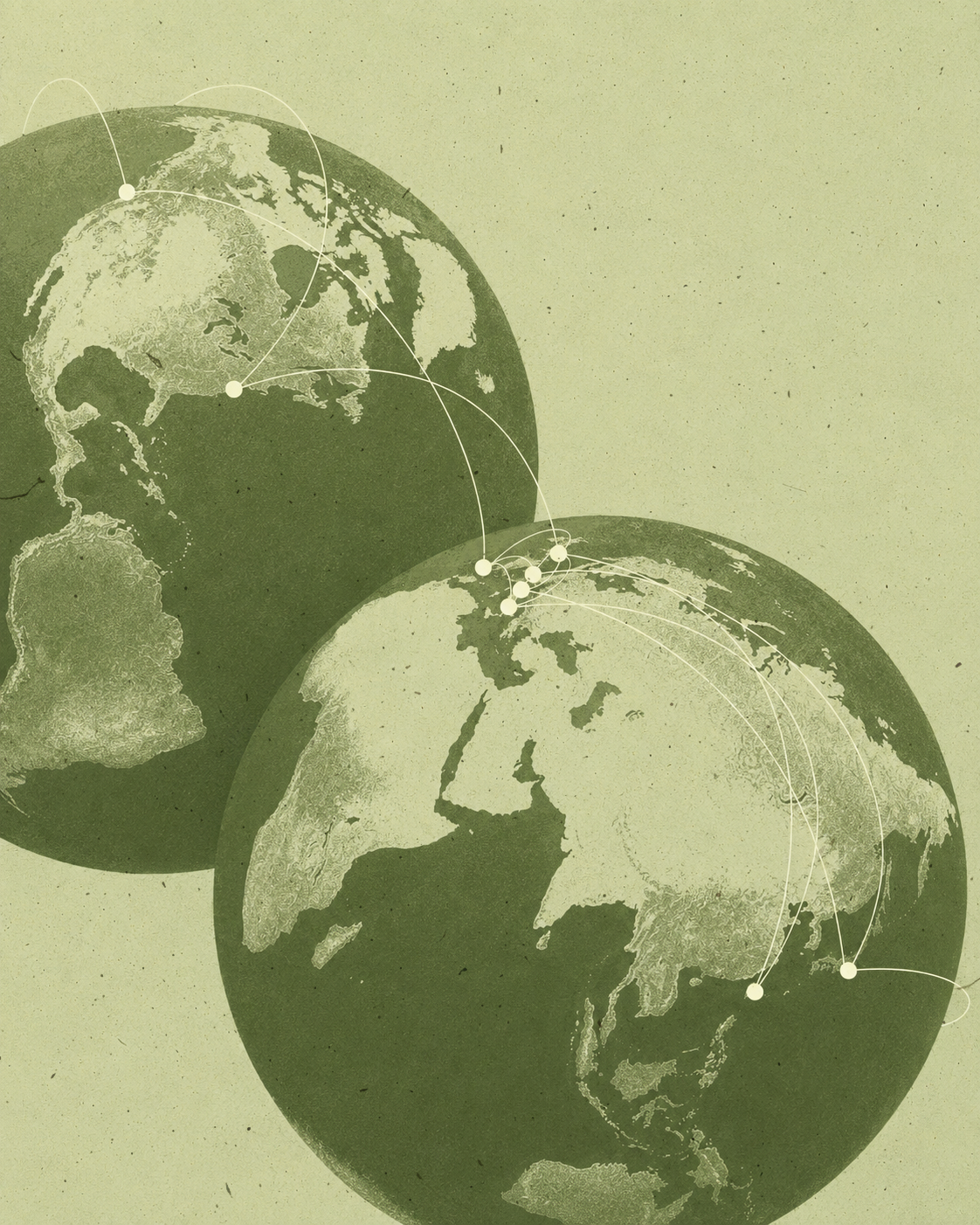
A network diagram of the project: nine nodes labelled with country and city codes (DE, US1, US2, CH, TW1, TW2, IT2, IT3, ES) connected by arrows tagged with hexagram characters showing who sent which postcard to whom. Below it, a triangular receiver-sender chart cross-tabulates the same exchanges. Two overlapping globes of the Earth rendered in olive tones, with thin white arcs connecting dotted points across continents — North America to Europe, Europe to East Asia — tracing the global movement of the postcards between the sixteen participants.
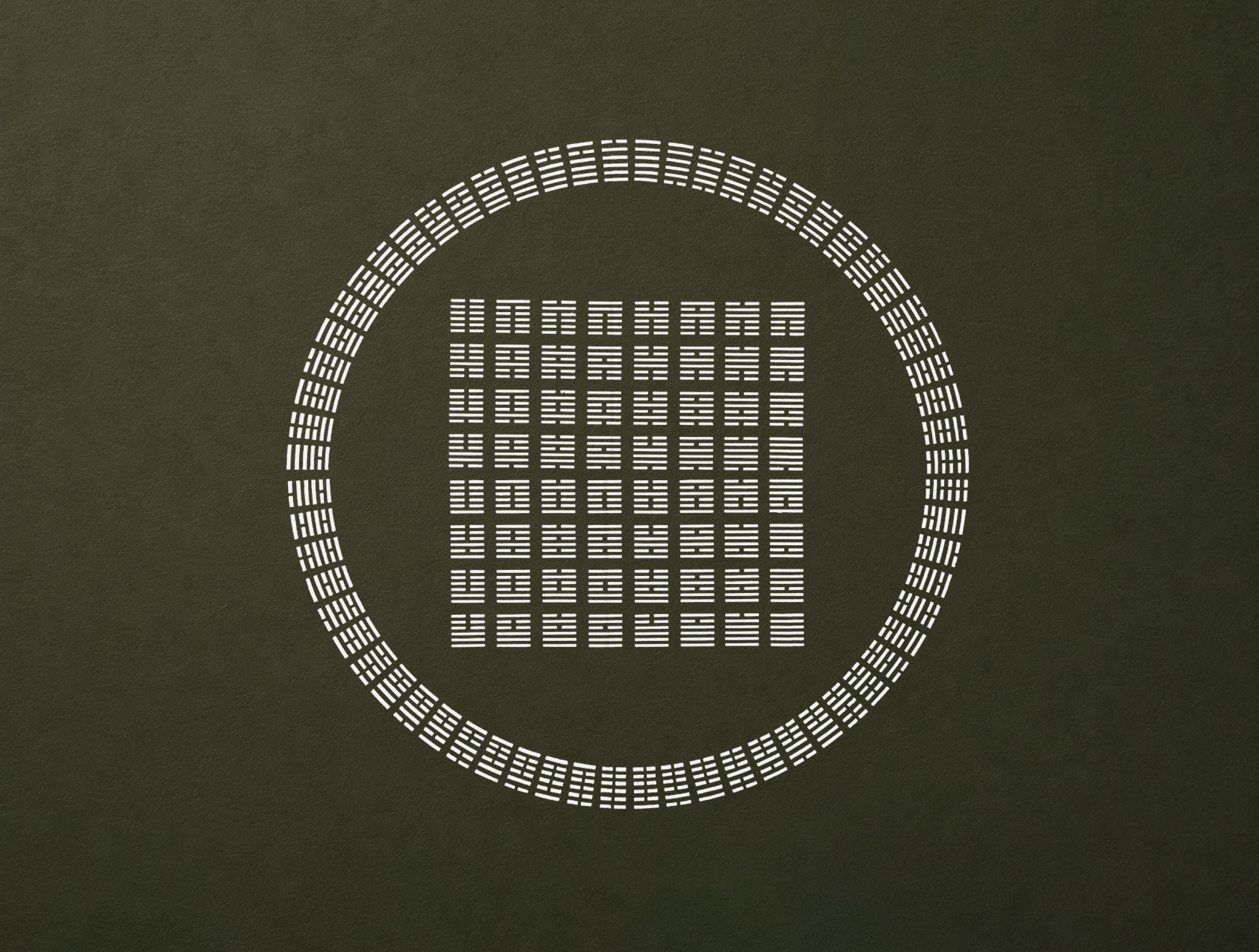
A poster on a dark green ground: all 64 hexagrams of the I Ching arranged in a thin circular ring around a central 8 by 8 grid of the same 64 hexagrams.
Pento jumper detail
Next project Pento Jumpers